
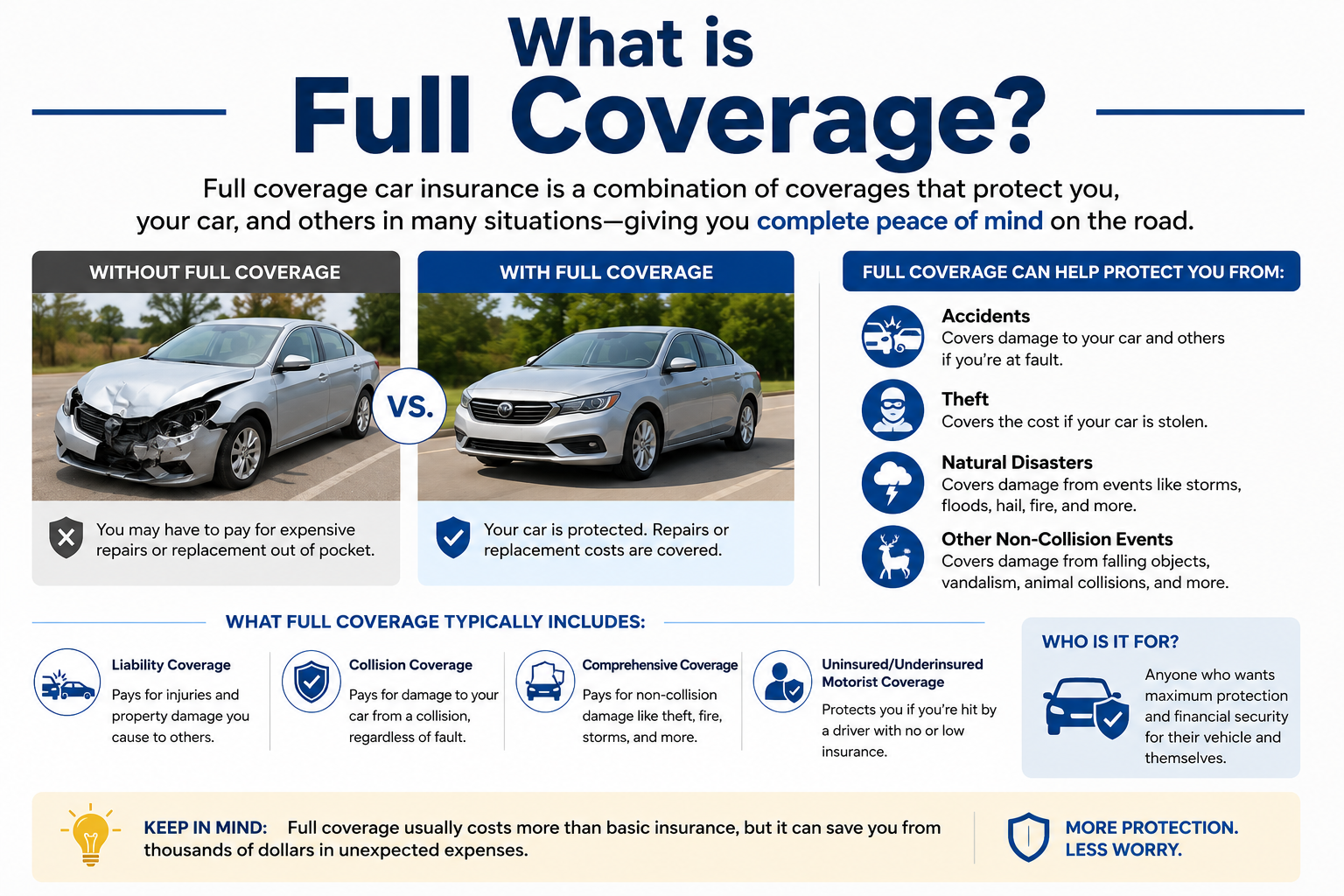
Full coverage is not a single insurance policy you can buy off a shelf it’s a popular shorthand for a package of three separate protections: Liability, Collision, and Comprehensive coverage, bundled together on one auto insurance policy. When people say they have “full coverage,” they typically mean their policy includes all three of these protections, giving them financial protection for damage they cause to others, damage to their own car from a crash, and damage to their own car from non-collision events like theft, fire, or weather. There is no industry-wide legal definition of the term, which is why understanding what actually makes up a “full coverage” policy matters before you buy or renew one.
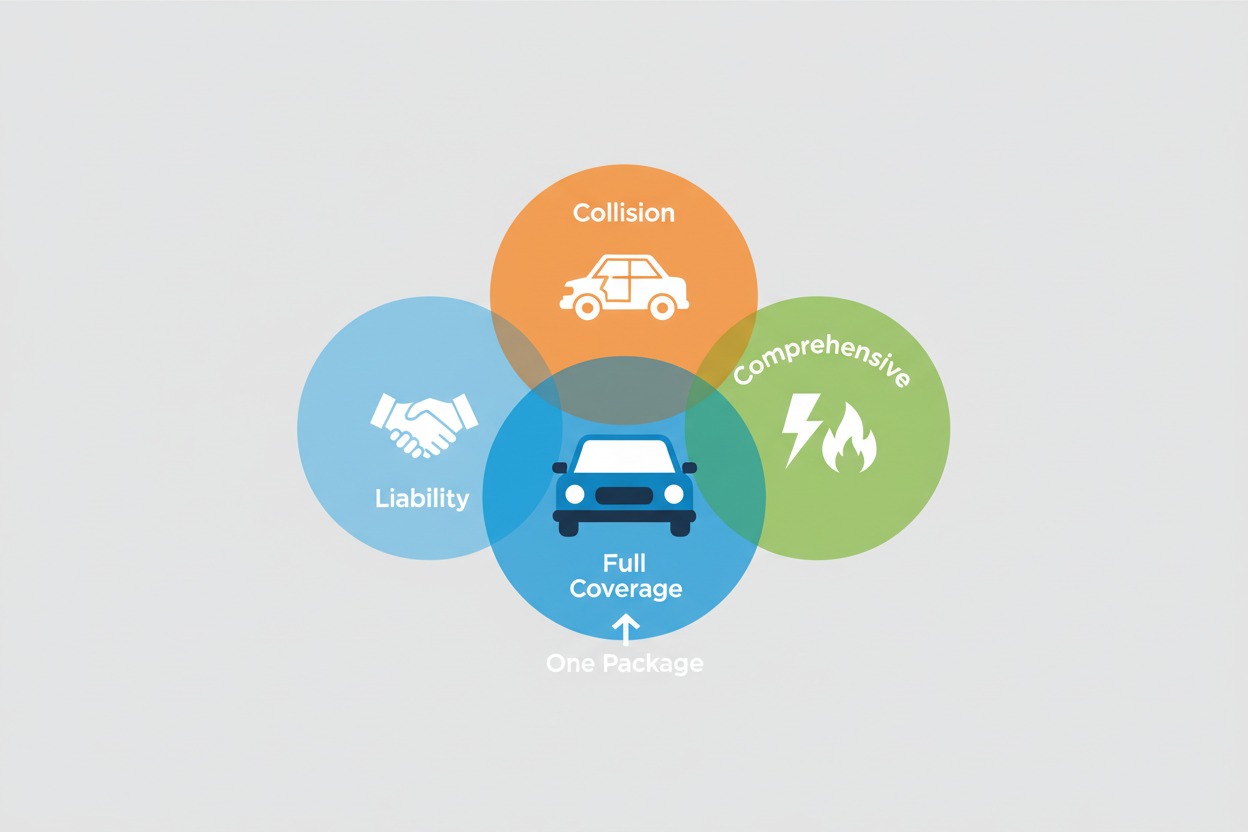
![Image description: A flat-design infographic showing a car at the center surrounded by three overlapping circles labeled “Liability,” “Collision,” and “Comprehensive,” with small icons (a handshake, a crashed car, and a lightning bolt/fire) representing each coverage type, illustrating how the three combine into one full coverage package.]
Why the Term Causes Confusion
Insurance carriers do not sell a product literally named “Full Coverage.” Instead, agents and drivers use the phrase informally to describe a policy that combines the coverages a lender typically requires with the coverages that protect the driver’s own vehicle. Because the exact mix can vary by state, lender, and insurer, two people who both say they have “full coverage” might actually be carrying different limits, deductibles, or add-ons. Below is a breakdown of the three core components that almost always make up this package.
The Three Pillars of Full Coverage
| Coverage Type | What It Pays For | Whose Damage It Covers | Typically Required? |
|---|---|---|---|
| Liability | Medical bills, lost wages, and property repairs for the other party after an at-fault accident | Other drivers, passengers, pedestrians, and their property | Yes, in nearly every state by law |
| Collision | Repair or replacement of your own vehicle after a crash, regardless of fault | Your vehicle | Usually required by lenders on financed or leased cars |
| Comprehensive | Damage to your own vehicle from non-collision events (theft, vandalism, fire, hail, flooding, falling objects, animal strikes) | Your vehicle | Usually required by lenders on financed or leased cars |
1. Liability Coverage
Liability coverage is the foundation of nearly every auto policy and the portion almost every state mandates by law. It is split into two parts:
- Bodily Injury Liability (BIL): Covers medical expenses, rehabilitation, and lost income for people injured in an accident you caused.
- Property Damage Liability (PDL): Covers repair costs to another person’s vehicle, fence, mailbox, or other property damaged in an at-fault accident.
Liability coverage does not pay for your own injuries or your own vehicle’s repairs. It exists purely to protect other people from the financial consequences of your driving.
2. Collision Coverage
Collision coverage steps in when your car is damaged in an accident involving another vehicle or object, such as a guardrail, pothole-induced rollover, or single-car crash into a tree. This coverage applies regardless of who caused the accident, which is what separates it from liability. It is subject to a deductible — an amount you agree to pay out of pocket before the insurer covers the rest.
3. Comprehensive Coverage
Despite its broad-sounding name, comprehensive coverage is specifically for damage that does not involve a collision with another vehicle. This includes:
- Theft or attempted theft
- Vandalism
- Fire
- Hail, hurricanes, or flooding
- Falling tree branches or other objects
- Collisions with animals (such as deer)
Like collision coverage, comprehensive carries its own separate deductible, which can be set independently of your collision deductible.
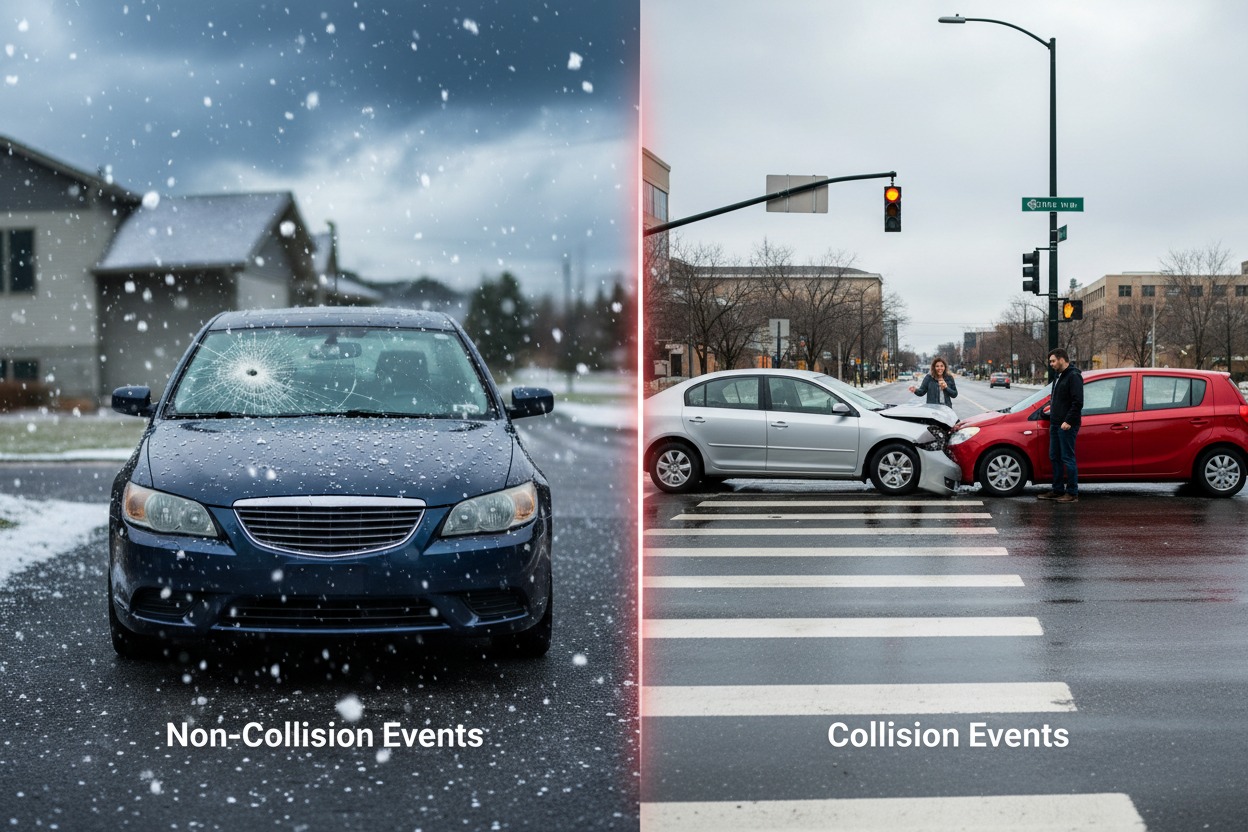
![Image description: A side-by-side split illustration the left half shows a car with a cracked windshield under falling hail (representing comprehensive coverage), and the right half shows two cars in a minor fender-bender at an intersection (representing collision coverage), with a clear visual divider labeled “Non-Collision Events” vs. “Collision Events.”]
How the Three Coverages Work Together: A Real-World Example
| Scenario | Coverage That Pays | Why |
|---|---|---|
| You rear-end another car at a stop sign | Liability (for the other driver’s car) + Collision (for your car) | You caused the crash, so liability covers the other party while collision covers your own vehicle |
| Your parked car is stolen overnight | Comprehensive | No collision occurred; theft falls under comprehensive |
| A hailstorm dents your hood and roof | Comprehensive | Weather damage is a non-collision event |
| You hit a deer crossing the road | Comprehensive | Animal collisions are classified under comprehensive, not collision, in most policies |
| Another driver runs a red light and hits you | Their Liability covers you; your Collision can cover you immediately while their insurer processes the claim | You can use your own collision coverage and let your insurer seek reimbursement from the at-fault driver’s insurer |
Is Full Coverage Legally Required?
No state requires comprehensive or collision coverage by law. What states do require, almost universally, is some level of liability coverage (a small number of states use alternative systems like no-fault insurance with personal injury protection). However, if you financed or leased your vehicle, your lender will almost always contractually require both collision and comprehensive coverage until the loan or lease is paid off, since the car serves as collateral for the loan.
Who Typically Needs Full Coverage?
| Driver Situation | Recommended Approach |
|---|---|
| Car is financed or leased | Full coverage (lender-mandated) |
| Car is paid off and worth more than a few thousand dollars | Full coverage often still worthwhile |
| Car is older, paid off, and low in resale value | Liability-only may be more cost-effective |
| Driver has limited savings to cover repair costs out of pocket | Full coverage reduces financial risk |
| Driver lives in an area prone to theft, severe weather, or wildlife collisions | Comprehensive coverage is especially valuable |
Weighing the Cost Against the Protection
Full coverage costs more than liability-only insurance because the insurer is taking on more risk — specifically, the risk of paying for your own vehicle’s repairs. Premiums for collision and comprehensive coverage are influenced by factors such as:
- The car’s market value and repair cost
- Your deductible amount (higher deductibles generally lower premiums)
- Your driving history and claims record
- Your location and local theft or weather risk
- The car’s safety ratings and anti-theft features
A common rule of thumb some financial advisors suggest is comparing your annual premium for collision and comprehensive against your car’s actual cash value; if the combined annual cost approaches 10% of what the car is worth, it may be time to reconsider whether full coverage still makes financial sense.
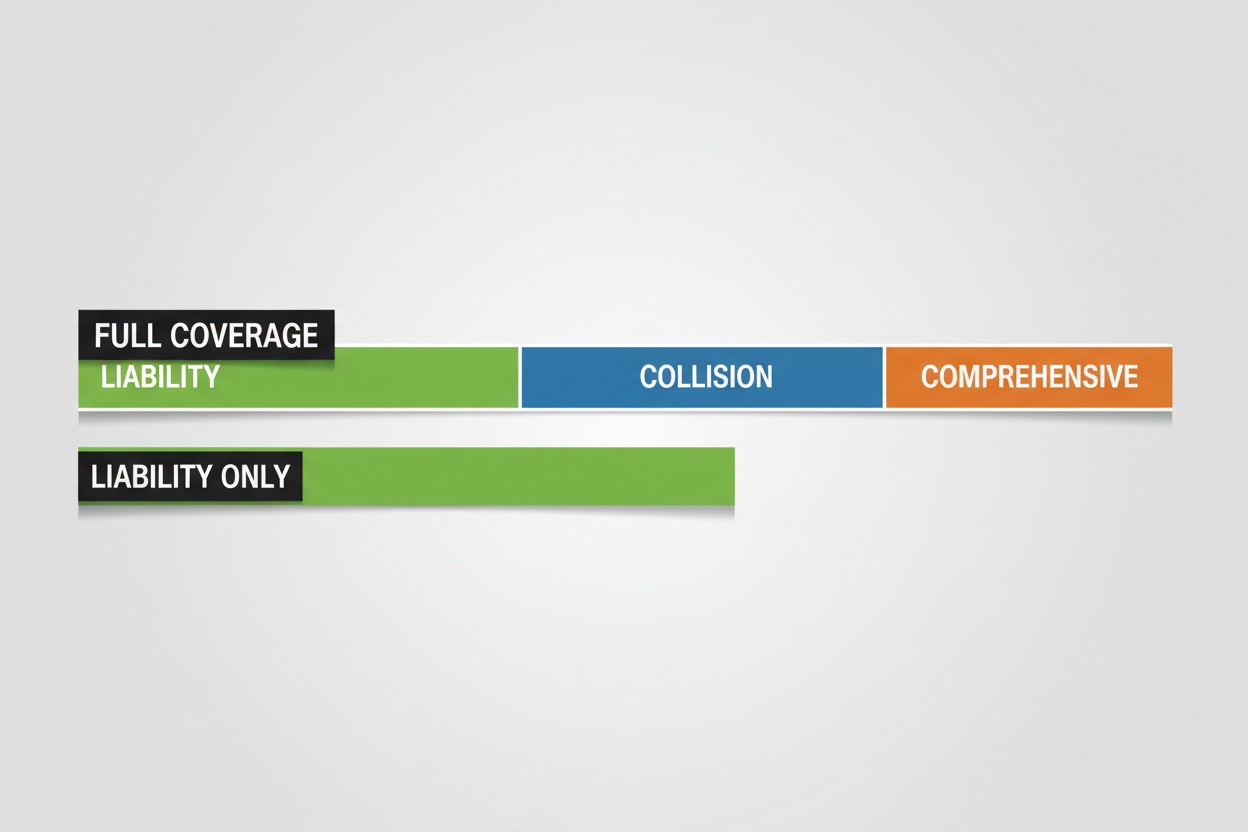
![Image description: A simple bar-style comparison graphic showing two stacked bars labeled “Liability Only” and “Full Coverage,” with the Liability Only bar shorter and colored green, and the Full Coverage bar taller and split into three colored segments representing Liability, Collision, and Comprehensive, visually demonstrating the added cost layers.]
Frequently Asked Questions
Does full coverage mean I’m covered for everything? No. Even full coverage policies exclude certain situations, such as normal wear and tear, mechanical breakdowns, or driving for a rideshare service without the proper endorsement. Always review your policy’s exclusions.
Can I drop full coverage once my car is paid off? Yes, once there’s no lender requirement, you’re free to adjust your policy. Many drivers switch to liability-only on older vehicles to reduce premiums, weighing the savings against the risk of paying out of pocket for repairs.
Does full coverage include roadside assistance or rental car coverage? Not automatically. Those are typically optional add-ons, separate from the core Liability, Collision, and Comprehensive package.
Key Takeaway
“Full coverage” is best understood as a combination, not a single product. Liability protects others from harm you cause, collision protects your own car after a crash, and comprehensive protects your own car from everything else, from hailstorms to theft. Understanding how these three coverages function individually and where their limits lie puts you in a far stronger position to choose the right policy, set sensible deductibles, and avoid being underinsured or overpaying for protection you don’t need.
This article is for general informational purposes only and does not constitute financial, legal, or insurance advice. Coverage requirements and options vary by state and insurer, so consult a licensed insurance agent for guidance specific to your situation.